- Org Training
- Live Workshops
- Full Live Course
- Psychological Safety Fundamentals
- Practice Masterclass
- Leadership & Management
- Advanced Psychological Safety
- Measuring Psychological Safety
- Workshop Design and Facilitation
- HOP Fundamentals
- Delivering Effective Feedback
- Thinking Like an Ecologist: A Field Guide for Organisational change
- On-Demand

- Org Training
- Live Workshops
- Full Live Course
- Psychological Safety Fundamentals
- Practice Masterclass
- Leadership & Management
- Advanced Psychological Safety
- Measuring Psychological Safety
- Workshop Design and Facilitation
- HOP Fundamentals
- Delivering Effective Feedback
- Thinking Like an Ecologist: A Field Guide for Organisational change
- On-Demand
What is Psychological Safety?
Most of us have sat in a meeting where everyone in the room could see a problem, and nobody said it. The decision went ahead. The thing everyone privately doubted turned out, later, to be exactly the thing that went wrong. That gap, the one between what we think and what we feel able to say, is what psychological safety is about.
Psychological safety is now a well-established term in organisational research, but the underlying problem is much older, and has been encountered independently in fields as different as psychotherapy, aviation, quality management, manufacturing and safety science.
Completely new to psychological safety? Start here. And check out our Psychological Safety 101 digital learning course.
"The belief that one will not be punished or humiliated for speaking up with ideas, questions, concerns, or mistakes, and that the team is safe for interpersonal risk taking" Amy Edmondson, 1999
Psychological safety is an emergent property of a group: not a personality trait, a vibe, or a management technique. When people within a group possess psychological safety, they can reasonably predict that others will react positively when they speak up, ask for help, admit a mistake, or challenge an idea. That positive predictability is what makes the risk feel worth taking. The better we can predict how a group will respond to us, the more willing we are to be honest within it. The opposite of that predictability — ambiguity about norms, expectations, or purpose — is one of the most reliable ways to silence people. Explore the definition of psychological safety here.

One final clarification before we go further: psychological safety is not the same as trust. Trust is a belief one person holds about another. Psychological safety is a belief about the group — about what it means to be a member of this particular team, in this particular context. You can trust your colleagues individually and still not feel safe to speak up in the group. The two are related, but they are not the same thing.
Why People Don’t Speak Up: The Calculus of Voice
Understanding what psychological safety is requires understanding why, in its absence, people stay silent even when they have something important to say. The calculus of voice is the psychological mechanism beneath speaking up.
Before “speaking up” (and speaking up may not be verbal – it may be a text, an email, a note, sign language, a nod, or something else), we run a rapid, usually unconscious risk calculation: what are the likely costs of speaking, and the likely benefits? It is fast, affective rather than deliberate, and it is running continuously, updated in real time as we read the room. It also doesn’t produce a simple yes or no. It has four possible outputs: say the thing fully; stay silent; soften and dilute what we meant to say; or change it entirely to please the listener. That third option — softening — is the most common, and it is exactly the move a junior officer makes when, instead of “stop, this is unsafe,” they ask a tentative question and hope it draws attention to the thing they’re concerned about.
“Positive interpersonal predictability”
To run that calculation at all, we need something to run it on: a prediction of how our vulnerability will land. This is why one of the most useful ways to understand psychological safety is as positive interpersonal predictability — not a vague sense of comfort, but enough confidence in how a group will respond to make the risk worth taking. We are, in other words, usually not managing danger so much as navigating uncertainty, which is why the word “safety” can mislead.
That prediction runs on data: what we’ve seen happen to others, how this person has responded before, the norms of the group, and (when local data is thin) more distant reference points like a previous boss or what we learned long before we ever entered this workplace. This is why telling a team “this is a safe space” rarely works: the declaration generates no data, and data is what the calculus needs. It also explains the counter-intuitive case of the hot-and-cold manager, who is in some ways harder to work with than a consistently harsh one. A predictably negative boss can at least be modelled and planned around; an unpredictable one resists modelling entirely, and under that kind of ambiguity our default is simply not to take the risk.
Power Gradients
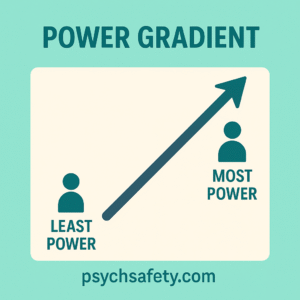
This is where power gradients become critical. The steeper the hierarchy — the greater the status difference between the person with something to say and the person they need to say it to — the higher the perceived cost of speaking. Decades of work in aviation safety, where this dynamic was called “authority gradient” or “cockpit gradient”, show that power differentials reliably suppress voice, and that the consequences of that suppression can be catastrophic.
Predictability is also unevenly distributed. Someone with tenure and informal networks has a rich predictive dataset; someone newer, more junior, or from a different background has fewer reference points and usually pays a higher price for getting it wrong. Making norms explicit isn’t only good practice, then — it is redistributive, transferring predictive capacity to the people who have least of it. And note where the mechanism sits: the calculus runs inside the individual, but the conditions that load it are structural. Locating the mechanism in the person is not the same as locating the responsibility there. The work is to reduce the cost of speaking up, not to coach people to be braver in conditions that haven’t changed.
We go deeper into the calculation itself in our Calculus of Voice article, and into predictability as its essential precursor in Ambiguity, Predictability and Psychological Safety.
Psychological Safety is Not One Thing: The Dimensions of Safety
It is tempting to picture psychological safety as a single dial that runs from low to high. It is more accurate, and far more useful, to picture it as dimensional. A person can feel entirely safe doing one kind of thing in a group and deeply unsafe doing another.
In one team, people might challenge each other’s ideas freely but never admit they don’t understand something — because asking for help is read as incompetence, and incompetence is punished. In another, asking questions is fine but questioning the decision of a manager is dangerous. The same person can be safe to speak with one colleague and silent with another, safe on one topic and guarded on the next. This is why a single team-level “score” can be misleading: it averages away the very variation that matters most. When we ask whether a team is psychologically safe, the better question is usually: safe for whom, to do what, with whom, about what?
That complexity is also one reason it is a mistake to treat psychological safety as a fashionable management technique. The underlying phenomenon keeps appearing in fields that developed independently of one another.
Is This Just a Management Fad? Convergent Evidence
A reasonable first reaction to psychological safety is suspicion: another piece of management language, another fad. The opposite is actually true, and the reason is worth understanding, because it is the strongest single argument for taking the concept seriously.
The same core insight was reached independently, across the twentieth century, by fields that were not talking to each other and were not trying to solve the same surface problem:
- Humanistic psychotherapy. Carl Rogers coined the term in 1954, describing the conditions under which people can stop performing and be honest.
- Aviation safety. Investigators studying cockpit disasters in the 1970s and 80s found that crews stayed silent against a steep “authority gradient”, and built Crew Resource Management to counter it.
- Quality management. W. Edwards Deming made “drive out fear” one of his fourteen points: anxious workers hide or diminish problems, and organisations that cannot see their problems cannot improve. We can’t fix a secret.
- Manufacturing. Toyota built the Andon Cord into the production line so that raising a concern was the default, expected action rather than a personal risk.
- Organisational scholarship. William Kahn brought the term into modern organisational research in 1990, and Amy Edmondson gave it its empirical foundation in 1999.
When separate fields, studying different surface problems, repeatedly encounter the same underlying dynamic — that fear, hierarchy and interpersonal risk suppress information, learning and challenge — that convergence is itself strong evidence that there is something real and consequential here. Read the full history here.
What Psychological Safety Looks Like in Practice
In the abstract, psychological safety can sound like a mood. In practice it is visible in ordinary behaviour — the things people do, or don’t do, in everyday work. In a psychologically safe team we tend to see:
- People asking questions without prefacing them with apology, and admitting “I don’t know” without it costing them standing.
- Mistakes reported early, including near-misses, weak signals, and small issues, rather than discovered late.
- Bad news travelling upward as readily as good news, and reaching the people who can act on it.
- Disagreement and challenge happening openly, including up the hierarchy, without it becoming personal.
- Quieter and more junior people contributing, not only the most senior or most confident.
- Help asked for and offered as a matter of routine, rather than as an admission of weakness.
None of this requires the absence of pressure, deadlines, or high standards. It requires only that honesty is not punished. Safety is not the same as comfort: a safe team is not a comfortable team; it is a candid one.
Signs of Low Psychological Safety
Low psychological safety is often quieter and harder to spot than its presence, precisely because its main symptom is things not happening: problems not raised, questions not asked, dissent not voiced. The absence is easy to mistake for harmony. Common signs that a team or organisation is low in psychological safety include:
- Meetings where everybody agrees, nobody disagrees, followed by corridor conversations where everybody does.
- Problems that surface only once they have become too large to hide.
- The same few voices speaking while others stay silent, especially the more junior or marginalised.
- Mistakes concealed, blame deflected, and “whose fault is it?” is asked before “what happened?” and “how?”.
- People who, before something happened, privately knew or suspected that something was wrong — and felt unable to say so at the time.
- A reliance on anonymous channels because named ones feel unsafe.
A useful diagnostic, borrowed from safety science, is simply this: when something goes wrong here, what happens to the person who names it first? The answer tells you most of what you need to know.
What Psychological Safety Is Not
This is worth addressing directly, because the concept is frequently misrepresented — usually accidentally, but sometimes in the service of dismissing it.
Psychological safety is not about making people comfortable. A psychologically safe team is not a team without conflict or challenge; it is a team where conflict and challenge can happen honestly, without fear of humiliation or retaliation. High standards and psychological safety are not in tension. In fact, the evidence consistently shows they reinforce each other: people are more likely to hold themselves and others to high standards when they feel safe enough to name problems rather than hide them.
Psychological safety is not niceness, and it is not the absence of accountability. It is not a guarantee that there will be no consequences for poor work or poor behaviour. It is the guarantee that you will not be punished or humiliated for being honest — for raising a concern, admitting you don’t know something, or questioning a decision.
It is also not something that leaders simply bestow on teams from above. The leader-centric framing — in which a manager creates psychological safety for their people — is a subtle version of the problem it claims to solve. Psychological safety operates vertically, between people of different status, and horizontally, between peers. Both matter. And the responsibility for building it is shared.
Finally: you cannot have too much psychological safety. Where research has suggested that high psychological safety produces unwanted team dynamics, the problem is almost always a lack of shared standards and expectations — not an excess of safety. We address that argument in more detail here.
Psychological Safety is Not the Same for Everyone
A team is only as psychologically safe as the least safe person on it. And the people with least safety are rarely distributed randomly.
We all bring our histories with us. Previous workplaces where speaking up had consequences. Educational and social environments that taught certain people, on the basis of gender, race, class, neurodiversity, sexuality, language, and more, that their contributions would be received differently to others. These are not personality quirks to be coached away; they are rational responses to real patterns of experience. Even in a genuinely safer environment, it takes time to unlearn lessons that were learned the hard way.
The mechanism here is the power gradient. Structural inequalities create steeper gradients for some people than for others, which means the personal cost of speaking up is higher for people who are already marginalised or disadvantaged. Psychological safety programmes that ignore this — that treat the team as a level playing field, or that measure average safety without attending to who is least safe — do not actually address the problem. They address the experience of the already comfortable.
This is also why psychological safety and inclusion are not entirely separate endeavours. Research confirms that diversity improves team performance, but only in psychologically safe environments. Without the safety to speak, the perspectives that diversity brings cannot actually enter the conversation. (Caruso and Woolley, 2008, in Edmondson and Lei, 2014.)
Psychological Safety and Accountability
One of the most persistent objections to psychological safety is that it is incompatible with accountability — that creating an environment where people feel safe to make mistakes means never holding anyone responsible for anything.
This gets it backwards.
Accountability requires honesty. The choice is not between psychological safety and accountability; it is between a culture in which problems surface early and can be addressed, and one in which they remain hidden until they are too big to ignore.
Not all mistakes are the same. Errors researchers distinguish between slips and lapses (competent people making the kinds of small errors all humans make), mistakes (decisions that seemed reasonable at the time but turned out to be wrong), and intentional violations. A culture of genuine accountability responds proportionately to these different types — supporting learning from the first two, and applying appropriate consequences to the third. A culture of blame treats all three the same, which means people learn quickly to hide the first two rather than report them.
The case of doctor Hadiza Bawa-Garba, convicted of manslaughter following the death of a patient in a severely under-resourced NHS setting, illustrates what happens when systemic failures are converted into individual culpability. The system that made the error possible remained unchanged. The individual who made an honest mistake in impossible circumstances was prosecuted. Psychological safety and just accountability are not opposites — but accountability without context is, functionally, blame. We explore this in detail in our article on accountability.
Psychological Safety and the Four Stages Model
The Four Stages of Psychological Safety is the work of Timothy R. Clark. It describes a progression from Inclusion Safety (feeling safe to belong) through Learner Safety (safe to ask questions) and Contributor Safety (safe to contribute ideas) to Challenger Safety (safe to challenge others and question the status quo). For many people, Clark’s model is their first encounter with the concept.
It is a potentially useful model. The progression from belonging through learning to contributing to challenging maps onto something real about how we calibrate our willingness to take increasing interpersonal risk in a group. As a framework for thinking about where a team is, and what might need to shift, it has some practical value.
It is also worth being clear about what it is not. People do not move through these stages neatly or linearly, and the stages do not exist as discrete, fixed realities in any given team. As we saw above, psychological safety is dimensional and contextual: someone might feel safe to challenge ideas in one meeting and not another, with one colleague and not another, on one topic and not another. A model that implies a single team-level stage can flatten exactly the variation that matters most. All models are wrong, and some are useful: this one is useful, as long as it is held lightly and not mistaken for a ladder every team climbs in order – otherwise it becomes harmful.
Westrum’s Cultural Typologies
Ron Westrum’s 2004 typology of organisational cultures describes how information flows through an organisation, and how that flow predicts behaviour when things go wrong. His three types — Pathological (power-oriented, messengers shot, failure leads to scapegoating), Bureaucratic (rule-oriented, messengers neglected, failure leads to justice), and Generative (performance-oriented, messengers trained, failure leads to inquiry) — map directly onto what we would now recognise as varying degrees of psychological safety.
Westrum was focused on physical safety in healthcare and aviation. The insight transfers. Organisations that want to know how psychologically safe they are can ask a simpler version of his question: when something goes wrong here, what happens to the person who names it first?
| Pathological | Bureaucratic | Generative |
|---|---|---|
| Power oriented | Rule oriented | Performance oriented |
| Low cooperation | Modest cooperation | High cooperation |
| Messengers “shot” | Messengers neglected | Messengers trained |
| Responsibilities shirked | Narrow responsibilities | Risks are shared |
| Bridging discouraged | Bridging tolerated | Bridging encouraged |
| Failure leads to scapegoating | Failure leads to justice | Failure leads to inquiry |
| Novelty crushed | Novelty leads to problems | Novelty implemented |
The Westrum organisational typology model: how organizations process information (Ron Westrum, “A typology of organisation culture,” BMJ Quality & Safety 13, no. 2 (2004), doi:10.1136/qshc.2003.009522.)
Closing the Gap: Work as Imagined and Work as Done
Organisations run on assumptions about how work actually happens. Those assumptions are often wrong. The gap between work as imagined — how we believe work is done — and work as done — how it actually happens at the sharp end — is one of the most reliable sources of risk, inefficiency, and avoidable harm.
Closing that gap requires honesty from the people closest to the work. And honesty from people closest to the work requires psychological safety — specifically, the kind of safety that allows someone to say “this is not how we actually do it” to someone with the authority to respond badly to that information. Without it, the gap stays open, and organisations continue to design interventions for a version of work that doesn’t exist.
In that sense, safety science arrives once again at the same underlying problem as organisational psychology, quality management and aviation: organisations cannot respond to information that people do not feel able to surface.
Measuring Psychological Safety
Psychological safety can be measured — through surveys that ask team members to rate agreement with statements reflecting group norms, qualitative approaches like the psychological safety matrix, which encourages teams to describe where they are rather than simply score it. Both have their uses: quantitative measures provide a baseline and a way to track change over time; qualitative approaches often surface the texture that scores miss. The best approach is usually combining both methods.
There are important considerations before measuring, however. Anonymous surveys in low-trust environments can themselves become a source of anxiety. Aggregated scores can mask the experience of the least safe people — the dimensional point again: an average hides the person who is least safe, who is usually the person who matters most. Measurement without a genuine commitment to act on what is found can do more harm than not measuring at all. Our measurement resources go into this in more detail.
Measure Psychological Safety – your free team survey
A survey you can tailor to your team, that comes back with a plan rather than a score, and tells you what’s already working so you can keep doing it.
The self-check is free, takes about five minutes, is for you alone and stores nothing. The team survey asks everyone anonymously and gives the whole team one shared picture — your first survey is free.
What you get
- You get a plan, not a score — a short, prioritised set of experiments chosen against what your team actually reported, ranked by fit and effort. Things you can try now. The sample report shows exactly what a team receives.
- It tells you why people hold back — there are many reasons people stay quiet, and each needs a different response.
- It shows you what’s already working — so you can do more of it. Most surveys only ever ask what’s broken.
- You hear what people wouldn’t say to your face — anonymity is built into the architecture.
- Built from over ten years of practice — across technology, healthcare, aviation, heavy industry and more. We draw on what actually works, and offer it to you.
Free
Anyone who wants to try it with their own team.
£0No card, no expiry
- One team, one survey
- The whole report, including the plan
- Anonymous by design
Team
A manager who wants to keep measuring the same team.
£60a year, VAT included
- One team, surveyed as often as you like
- Reports that show what changed
- Everything in Free
Practitioner / Consultant
For consultants, coaches, facilitators and internal practitioners working with several teams.
£260a year, VAT included
- Up to ten teams, each with its own history
- Use it with your clients, and charge them if you like
- 10% off all Psych Safety training
Organisation
An organisation rolling it out across teams.
Contact usInvoiced annually
- Multiple organisers, one administrator
- Seats you assign yourself
- An organisational dashboard
Prices include VAT. Compare the plans in full.
The Benefits of Psychological Safety
When people feel safe to speak up, ask for help, admit mistakes, and challenge ideas, organisations learn faster, make fewer errors, and recover from them more quickly. New ideas surface rather than staying trapped in the heads of people who assume no one wants to hear them. Risks that would otherwise stay hidden until they become crises are named early. People stay — because working somewhere that treats honesty as a strength rather than a liability is, quite simply, a better place to work.
These outcomes are well evidenced. Google’s Project Aristotle — a large-scale study of team performance — found psychological safety to be the single most important factor distinguishing high-performing teams. The State of DevOps reports have consistently identified it as foundational to software delivery performance and organisational resilience. Our own research, including work on the relationship between job security and psychological safety, on why people foster psychological safety, and on the barriers that prevent it from taking hold, points in the same direction.
But the case for psychological safety doesn’t rest only on organisational outcomes. A team in which people cannot be honest — cannot ask for help, cannot name what they’ve seen, cannot be themselves — is asking people to spend a significant part of their lives performing safety rather than experiencing it. That is worth addressing on its own terms, independent of what it does for productivity.
Our Research
At Psych Safety we carry out our own research on psychological safety alongside our practice work. Our studies have explored the relationship between job security and psychological safety — finding that precarious employment significantly undermines the conditions for safety — examined why people choose to foster psychological safety, and investigated the structural and organisational barriers that prevent psychological safety from taking root even where it is genuinely valued. That last body of work is particularly important, because it moves the conversation from individual behaviour change toward the conditions that make behaviour change possible.
Categories
- Newsletter (332)
- Psychological Safety (337)
- Create and Maintain (46)
- Human and Organisational Performance (HOP) (72)
- In Technology (16)
- Learning and Development (19)
- Measure (28)
- Psychological Safety In The Workplace (224)
- Theory and Research (73)
Tags
Sign up to our newsletter & get weekly insights and research

